7/5/2022, jeff
jack daniels' distance running notes
in high school, i was coached using a lot of jack daniels' methods, which focus on slow, methodical fitness building using quantitative benchmarks. i think it's an extremely effective approach, and i made sure to keep the few materials about it that i was given. i'm providing a faithful, but edited version of those materials here to allow aspiring runners to access them. i'll put any notes i have into italics like this.
suggested reading: there's a lot here, and most of it is pretty good, but any section with 'training' in it (principles of training, training plans, training intensity) is can't-miss content.
jump to section
laws of coaching
- treat every runner as an individual who has unique strengths and weaknesses. time available is not the same for all, and background varies a great deal among individuals. i'm only mentioning this because i think my coach might have misinterpreted it - i believe this means that stronger, self-motivated runners may need less time than runners still seeking direction
- always find positive comments that you can give regarding how training is going
- everyone has good and bad training days
- subject your runners to various types of training to find what feels best
- encourage being flexible in regard to changing workouts, days of training, etc.
- support the idea of not training while ill or injured - care for health concerns. i think coaches disregarding this principle are depressingly common, and tells me instantly that they are bad at their job
- when you have runners run together, make sure they run together
- try to eliminate the feeling of inferiority to others who are doing more training
- teach your runners how to breathe properly
- teach your runners how to use an economical running stride
- use intermediate goals that pave the way for long-term success
- expose your runners to a variety of flexibility and warm-up exercises
- encourage good eating and sleep habits and teach proper hydration
- don't worry about sleep the night before a big race - eliminate negative thoughts. not sure if this is like 'don't worry the night before a race' or 'don't worry, the night before a big race isn't as impactful' but...either way, i guess
- learn as much as possible about coming race conditions - course, weather, etc.
- have your runners experiment with shoes, socks, clothing, visors, caps, etc.
- there is no such thing as a "fluke" good run; there may be fluke bad runs play it again! if you don't remember anything else, remember this!
- training should be rewarding; not always fun, but always rewarding
- trust positive responses to training, question any negative responses
- no one should feel bad during training runs; if so, there is a health problem, possibly: diet, sleep, losing weight, dehydrated, illness, over-training
- be available to your runners
- consistency is the key to success as a runner
- when running, concentrate on the task at hand think about your form, think about your breathing, think about how your body feels, and so on
- learn proper pacing for various distances
- most mistakes are made early in a run so be alert to improper pacing
- use your head during the majority of a race, use your heart later in the run
- care about your athletes first as people, then as runners preach, baby
principles of training
- the body reacts to stress. there are two types of reaction to exercise stress. one is an acute reaction, the type you get when you go for a single run. heart rate is elevated, blood pressure rises, you feel fatigue, and so on. the other type of reaction is the kind you get from repeated exercise (training). muscles that are stressed repeatedly become stronger and blood flow becomes more generous. the muscle cells provide more energy, and less lactic acid builds up. your resting heart rate drops as your heart grows stronger. chronic acute reactions to physical stress produce long-term reactions that in turn reduce the severity of the daily stress.
- the system which is stressed is the one that stands to benefit from the stress. while training for one sport usually has little or no beneficial effect on your ability to perform a second sport, in some cases there may actually be a detrimental effect. for example, long-distance running hurts explosive ability in the legs (the dichotomy between slow- and fast-twitch muscles). to be really accomplished at something, you must practice doing that thing, not some other activity, which may not only take time away from the activity of primary interest, but may also produce results which limit performance in the main sport. this is not to say that all non-specific activity is bad, but considerable thought must be given to every aspect of training, and you must know what everything you do is doing for (or to) you.
- over-training has a negative impact on the systems that are overstressed. this is the natural endpoint of the body reacting to stress. too much stress, and something breaks. something to note here is that too much running does not always mean that you are overstressed in other types of physical activity, and it may be beneficial to limit running for periods of time in favor of other types of training.
- a specific stress produces a specific result. this principle really says that the benefits that can be expected from a specific training plan are specific to the frequency, load, intensity, and recovery. for example, someone who runs three times a week doing 3x 1-mile runs at 8 minutes each, with 5 minutes of recovery in between, is experiencing a frequency of 3 times/week, a load of 3 miles/run, an intensity of 8:00/mile, and a recovery of 5 minutes. this specific stress naturally will produce a different, stable result than someone doing the same workout at an intensity of 7:00/mile instead. the follow-on to this is that once a specific stress becomes comfortable, any of those four levers (frequency, load, intensity, and recovery) can be tweaked to produce a new stress, resulting in a new level of fitness. this is one of the most important aspects of daniels' philosophy, in my opinion. this gives you a way to quantitatively measure and adjust the workouts you perform, and evaluate your overall comfort with the regimen to determine whether or not to step it up a notch.
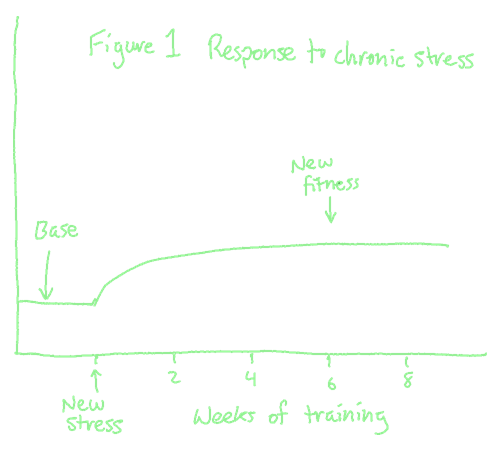
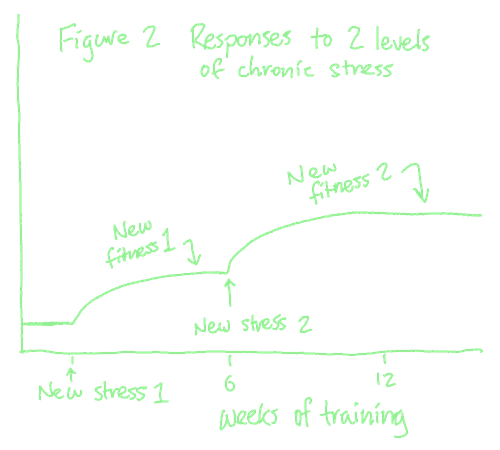
- rate of achievement is not linear. this principle is depicted by the curves in figures 1 and 2 below. you will notice that the rate of achieving the ultimate benefits of a training program is rapid at first, then tapers off over time. a look at the time scales on these curves shows that most of the benefits are quite adequately realized in a matter of four to six weeks. it's worth noting that sticking with a training program for longer than six weeks may continue to produce more benefits, especially in terms of body composition; however, quite adequate benefits are realized in a matter of weeks. the danger of increasing training too often is primarily increased risk of injury or overstress. it is very difficult to get a feeling of what a particular training load is doing for you if you don't stay with it for a while. keeping in mind that you're looking at my recreations of these figures, they're still qualitative bullshit, and i am taking daniels' word for it that the numbers here are good. i trust what he says, but i am not going to suggest that you necessarily need to do the same.
- each individual has unique personal limits. for example, there is a limit as to how tall you will be, how strong a particular muscle in your body can get how much air you can breathe in and out of your lungs, how much blood can be transported to your running muscles, how much oxygen your running muscles can use in converting fuel to energy, and how fast you can run a mile, a 10k, or a marathon. it may be sad, but we all have limits, and these limits can vary greatly from individual to individual. different ones of us will reach different degrees of success, which are greatly dictated by what our limits are. the good news is that few people realize their limits relative to running, and improvement is almost always possible.
- increasing training load produces diminishing returns. the curve in the upper left of figure 3, below, uses mileage to clarify this principle. take a runner who starts training at 10 miles a week. after some amount of time, they double their weekly mileage to 20 miles/week, then again to 40 miles/week, then once again to 80 miles/week. it doesn't matter how long this takes to happen. the fitness achieved at 20 miles/week is not double the fitness at 10 miles/week, just as the fitness at 40 miles/week is not double the 20 mile/week fitness (or 4x the 10 mile/week fitness, and so on). adding more mileage to your weekly training does not produce a proportional improvement in fitness. the same applies to faster, quality training. this is significant with respect to the fourth principle, which gave us the four levers of frequency, load, intensity, and recovery. daniels here is targeting load (and intensity, briefly) as aspects of training that are probably over-prioritized and abused. i'm doing a bit of between-the-lines here, but it's a good reminder to keep things balanced.
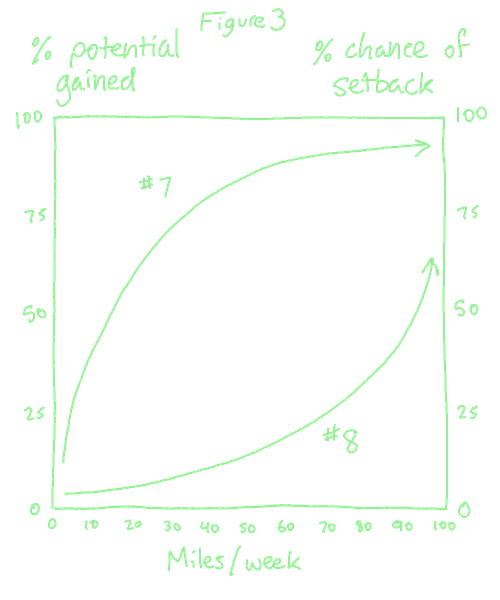
the only thing i didn't include in this figure is a dotted vertical line extending through the chart at 60 miles/week. the idea is that this is the maximization of benefit at the minimization of risk. i agree that for races up to a marathon, you probably want to stick in the 40-60 miles/week range, and this chart is a good visualization of that conventional wisdom.
- increasing training load produces accelerating setbacks. this is the complement to the seventh principle, represented by the lower right curve on figure 3, above. a setback could be an injury, an illness, or even a lack of interest in training. whatever it is, setbacks must be avoided at all costs. low levels of training produce few setbacks, and as a person trains harder and harder, the potential for setbacks increases exponentially.
- effort to maintain is far lower than effort to achieve. this principle holds especially true for maintenance of a level of competitive ability, which must at least in part be a function of reaching a particular level of confidence. although this refers primarily to physiological fitness, it is no secret that psychological factors play a role in how fast you can race. once you break the 5 minute mile barrier, doing it again is not the task it was the first time, and the effort required to repeat the task is usually well short of what was initially involved. this principle is an important one to consider when planning a long-term training plan, because it allows you to shift your training emphasis from one system to another while maintaining the benefits through less frequent attention.
- time erodes memory. you always tend to forget how hard you trained earlier in your career when you are disappointed by how hard it is to make a comeback. this is the natural run-on from the ninth principle. yes, you forget, but it's also much harder to regain lost fitness than it is to maintain current fitness. being patient with yourself is one of the hardest things to do in the year of our lord 2022, but it is of absolutely vital importance, especially if you have a history of high achievement in running.
aerobic profile
the following discussion summarizes the importance of vo2max (maximum oxygen consumption), running economy (vo2submax), and lactate threshold (threshold) for a distance runner.
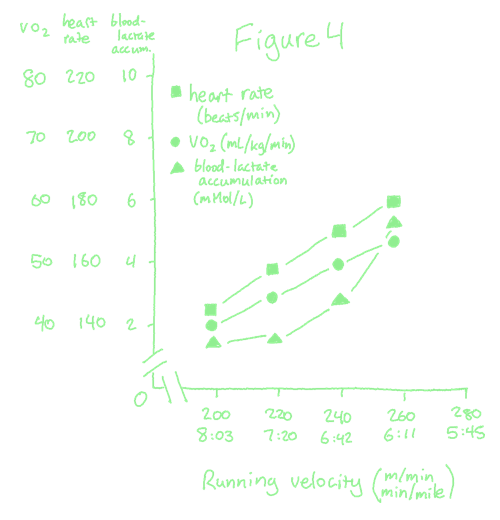
let's say we have a runner who has reached a "steady state" of exercise by running for about six minutes at a sub-maximal speed (8:00/mile, in this example), and a bag of expired air is collected from this runner during the final minute or two of this run. the analysis of this runner's expired air will tell us what the aerobic (i.e. oxygen) demand of running at 8:00/mile pace is for this particular runner. heart rate, also taken during the final minute or two of the run, as well as a small, finger-stick blood sample, will provide information on the pulse rate and blood-lactate accumulation associated with this velocity of running for this particular runner.
if the same procedure is repeated several times at increasingly faster (but still sub-maximal) velocities, then the vo2, heart rate, and blood-lactate accumulation responses can all be plotted against running speed. figure 4 shows such data (which apparently is real data collected on one of daniels' athletes). notice that vo2 and heart rate response is relatively linear. blood-lactate accumulation, on the other hand, shows a different picture. easier running speeds show little change in blood-lactate accumulation, but as the speed of running reaches a more demanding intensity, there is a dramatic increase in blood lactate. this curve is typical of what any runner would show, with the exception that the better the runner, the faster would be the running pace at which the lactate response curve would demonstrate the change from a flat to a rather steep slope. the intensity at which this transition from a gradual to a steep lactate curve takes place is referred to as this individual's lactate threshold intensity.
if the runner being tested completes three or four submax tests at increasingly faster speeds, up to about 10k race pace or a little faster, before performing a "max" test, the response picture becomes adequate for determining current training, and even competitive intensities of running.
as with the other figures i've recreated, this chart is best used as a qualitative comparator. while heart rate and vo2 increase in a linear fashion, blood-lactate accumulation increases exponentially. the main idea that daniels will be expounding on in great detail is to flatten the curve to delay the buildup of lactic acid in the blood for as long as possible.
the max test is one in which the runner starts running at the same pace as was used in the final submax test (approximately 10k race pace). this speed is held for two minutes. after this initial two minutes, a 1% grade is added to the treadmill every minute (or, in a track test, the pace increases to 5k race pace). the test continues until failure (or after three to four laps in a track test, with the final lap at an all-out sprint). expired air samples are continually collected, starting at the third minute and ending when the test is over. heart rate is taken at the end of the test. the final blood sample is drawn two minutes after the end of the test, when blood lactate reaches its peak.
by adding the highest vo2 measured during the max test (this is vo2max) and the maximum heart rate and blood-lactate accumulation to the submax data, you gain a picture of a runner's "aerobic profile", illustrated in figure 5. vo2max is placed on an extension of the economy curve (the line drawn through the previously-calculated vo2submax data points), and this permits the determination of the velocity at which vo2max would first be realized (if this doesn't make any sense to you, don't sweat it - i have no idea what the fuck he's talking about here. vo2max would therefore just be reached at your maximum velocity, unless the line tapers off at some point. or maybe you're just supposed to plot it on the extrapolated line, to "solve" for the value on the x-axis. god, that would be abhorrent). this velocity is called vvo2max (velocity at vo2max) and is used to calculate a "vdot" value, which, in turn, determines training paces and race potential.
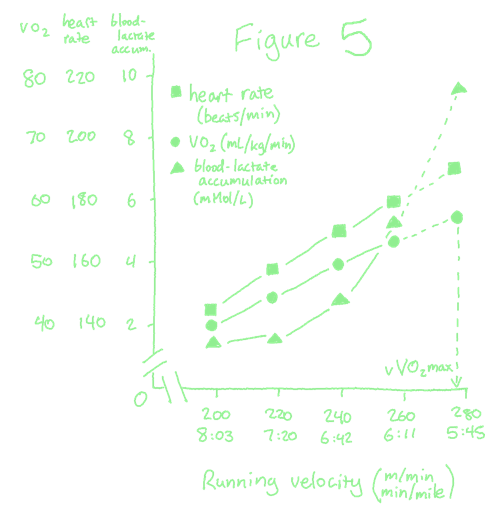
i recreated this chart faithfully, though it pained me to do so. i am highly skeptical that these numbers are real, though i can't say for sure.
by now it should have become apparent that the measurement of vo2max, by itself, provides very little information in terms of discriminating between groups of good runners. news that some runner was found to have a vo2max of 90ml/kg/min elicits two immediate reactions. first, that the tests may be poorly controlled, and second, if the tests were well controlled, why doesn't this runner outperform everyone else, hands down?
assuming that this runner with the high vo2max really does have an accurate assessment of his aerobic capacity, the most logical reasion why he doesn't outperform everyone else is because his economy is poor. when a runner with a 70 vo2max runs a 2:10 marathon and outperforms a 90 vo2max runner, imagine how poor the latter's efficiency must be. and who is to say that the 90 vo2max runner can improve efficiency (economy) any more than can the 70-max runner improve his vo2max? learning your actual vo2max can be useful for monitoring changes in response to training, but learning your vo2max without supporting information concerning your economy can be misleading. i'll admit, it's been a long time since i've read this closely. this could have easily been a sentence or two, but daniels going on a rampage to stomp wunderkind media darlings is pretty funny, even if it is a little much.
keep in mind that vo2max, economy, and lactate accumulation all respond to training. specific types of training should be used to optimize each of these components of performance. an important relationship between vo2, heart rate, blood-lactate accumulation, and vvo2max should be pointed out here. the configuration of the economy curve (vo2 versus running velocity) is such that a 1% change in velocity is nearly also a 1% change in vo2. this results in an intensity of 70% vo2max being equal to 75% vvo2max, and an intensity of 88% vo2max being equal to 90% vvo2max.
this relationship is extremely useful. it signifies that if vvo2max can be identified, there is no need for vo2max or economy testing for the purpose of setting training intensities. fortunately, current vvo2max can be estimated from the race performance capabilities of a runner (i.e. you can use current race information to determine how hard to train. furthermore, this is a better way to do it than laboratory tests. further, laboratory testing is simply not necessary for the masses of runners and coaches who should be using more concrete information to plan training intensities. after all, what is better than using how good you are as a measure of how fast you should run? jack are you fucking kidding me right now
training plans
what a runner is really trying to accomplish through training are the following:
- improve the body's ability to transport blood and oxygen
- increase the ability of the running muscles to effectively utilize their available oxygen to convert carbohydrate and fat fuel into useful energy
- increase vo2max, which is a sum of #1 and #2, above
- shift lactate threshold to correspond to a faster running speed
- improve speed
- lower the energy demand of running (improve economy)
naturally, there are other goals of training, such as improving race tactics, elevating self-confidence, changing body composition, bettering self-image, etc., but these less-tangible factors will all result from improvement in one or more of the above-mentioned factors. i'm not 100% sure about this. i think that while mental training can be performed simultaneously to physical training, it is separate and deserves significant attention, especially when preparing for longer races (halves and up). any mental or emotional benefits of daniels' methods are accidental, not causal.
there are several different types of running that contribute to training, each with their own intensity:
- e and l runs: easy runs to recover from strenuous periods of training or to carry out a second workout on a particular day should be carried out at e (easy) velocity, which is about 60-70% of vo2max. long runs should be carried out at this pace as well. be advised that the benefits of e pace running are more a function of time spent exercising than intensity of running, and that 60-70% vo2max (corresponding to 65-75% vvo2max and 65-75% maximum heart rate) is as hard as you need to go to get the benefits you want at the cellular level and in the heart muscle.
- m runs: the next faster intensity of training is m (marathon) pace, and is pretty much limited to marathon training. m is relatively self-explanatory: it's the pace at which you plan to race in your next marathon, and for beginner runners is about 20 seconds per mile slower than t pace, described below.
- t runs: t, or threshold, pace is about 84-88% of vo2max (86-90% of vvo2max or maximum heart rate). subjectively, t pace is "comfortably hard" running. for many people it is slower than 10k race pace and 24 seconds/mile slower than current 5k race pace. t pace improves your lactate threshold, so it is important to stay as close as possible to the prescribed speed; neither slower nor faster speeds do as good a job as does the proper velocity.
- i pace: the next important training velocity is the one that stresses and improves vo2max, i, or interval, pace. the intensity here should be equal to vvo2max. most people should shoot for 95-100% of maximum heart rate, rather than always demanding 100%. no single interval should exceed 5 minutes. training at i pace is demanding, but by no means is it all-out running. in the case of i pace, the harm of going too fast is that no better results are obtained and the excessive pace will probably leave you overstressed for the next quality session. something important to note in these last two bullet points is the emphasis on not running too fast. while training, it is not better to run faster, and is in fact much worse than running the appropriate pace. save the showing off for race day.
- r pace: r, or repetition, pace is faster than i pace, at least, but unlike i or t, is not based on vo2max. r pace is instead based on the race for which you are training, and is designed for good mechanics at a pretty fast pace. two runners, one training for the 1500 and one for the 10k, will have different r paces even if they have the same vo2max (meaning their i and t runs are at the same pace). unlike intervals, reps are not particularly "hard" in nature, primarily because they have a short duration and are punctuated by full rests. keep in mind that the purpose of r pace training is to improve economy and speed. it is not to benefit vo2max or lactate threshold.
building on to that final statement, it is important to always have set in your mind what every workout is designed to do for you, even if that benefit is pure relaxation. thinking about these intensities in terms of daniels' training principles, it makes sense to focus on either m, t, or i workouts during any specific training cycle, as they each stress a different system. additionally, along the lines of daniels' training principle that says that few athletes ever reach their full potential, i think most people can reap benefits from any of these kinds of workouts, regardless of race distance.
in addition to running, there is also support system training, or supplemental training. this type of training varies greatly from runner to runner, and is designed to produce fewer direct benefits. support system training includes flexibility, muscle strengthening, mental/psychological approaches to performance enhancement, and so on. as with all types of training, be sure what you are doing helps satisfy the needs you have and doesn't just add unproductive activity to your training program. often, trial and error is the only way to see if something works for you, and always remember to give a new training approach a fair trial, not just a few days. i agree that when you are young and running short distances, accumulating running time should be your top priority by a long shot; however, as a person gets older and as the races get longer, the gulf between running time and this support system training begins to close. to be fair to daniels, his methods are focused on performance in shorter races, and people adapting them for marathons or even into ultras should be prepared to approach them in this context.
by using standard values for running economy (i.e. if your form doesn't suck ass, lol) and having a timed performance over a known race distance, a fitness (vdot) value can be assigned to you for training and race-prediction purposes. don't try to beat the assigned training intensities. to train faster, you must first justify a higher vdot by racing better or by performing 4 weeks of consistent training.
daniels includes a couple big-ass tables here to look up your vdot based on race performance, then look up your training paces based on that vdot. thanks to the power of the web browser, i'll just build a small tool to do it instead. if you can't get it to work, let me know and i'll email you the full tables.
when starting to train an individual or group of individual, the coach should first consider the following:
- psychological factors: stress, time demands, etc.
- biomechanical factors: imbalances, etc.
- physiological factors: medical restrictions, etc.
- sociological factors: work, family, friends, etc.
however, coaches often react from experience, simply doing whatever their coach did, or by following the training regimens of current champions. these reactions can spell disaster because basic principles of training are often not followed. it is wise to often review principles of training (outlined in an above section) so you will be ready for how your runners react to their training program.
information a coach needs regarding the people being coached:
- previous mileage, both in recent weeks and anytime in the past
- previous race performances, if any
- goals, short term and long range
- commitment, how much available time, etc.
- facilities available: indoor track, treadmill, etc.
- personal concerns
with this information, they then plot out the actual training program, attending to the following:
- building a resistance to injury
- building an aerobic base
- improving individual weaknesses
- taking advantage of individual strengths
- using competitions wisely
an ideal season of training would be several 6-week phases, but in certain situations, time is limited, and adaptations must be made to what is considered the ideal approach. a few rules will help prepare for a formal training plan, and reduce the severity of potential adaptations:
- set a realistic peak amount of weekly mileage for the entire program.
- if you have not been running prior to the start of the program, daily training should not exceed 30 minutes, and 30 minutes may seem like a lot.
- without any races to calculate a vdot, train subjectively: e and l runs are easy and conversational, t runs are comfortably hard.
- if you do have a vdot, use that vdot for at least 4 weeks before letting a better race performance increase your vdot. if training is going well, but you don't race, feel free to increase your vdot by one after 4-6 weeks of consistent training.
- always breathe with a 2-2 rhythm (2 steps in, 2 steps out), and learn to take 180 steps (90 each foot) each minute using short, quick steps.
- practice drinking on l runs.
stride rate
one of the first things new runners should learn (and often one of the last things new runners learn) is proper stride rate or frequency, commonly referred to as "turnover".
there are only two ways to increase the speed at which a runner can get from point a to point b. one is to increase stride length without slowing down stride rate, and the second is to increase turnover without shortening stride length. generally speaking, an increase in stride length demands greater energy expenditure (and typically getting stronger), whereas an increase in stride rate is pretty much a voluntary thing and may not simply prevent increased energy demand, but decrease energy demand instead. daniels will expand on this in a moment, but you can think of a runner's speed as a function of their stride length and frequency. the motivation for this section is that most new runners tend to have a stride frequency that is lower than optimal. it's been a while since i talked to runners about running, but i do wonder if this has changed since the new age of barefoot running starting in the 2010s.
imagine running with very slow, exaggerated steps. a slower turnover means you spend more time in the air, which in turn means lifting your body mass to a greater height, which costs energy. now, if the extra cost comes with a faster running pace, then the cost may be worth it, but if the increase in pace is not worth the cost then you are working more than necessary to get the job done. possibly even more important is the fact that a longer stride rate, and accompanying greater body lift, means coming down harder on each foot strike. landing impact is the greatest cause of injury in runners. if you take 90 steps per foot per minute, that's 5400 foot strikes per hour, and 21,600 foot strikes over a four hour marathon. with a longer stride, this frequency could decrease to 80 strides per minute. this would decrease foot strikes by 600 per hour, to a total of 19,200 strikes for a four hour marathon. though the total number of foot strikes is reduced, the cumulative impact ends up being much greater (thanks to acceleration due to gravity).
studies that have measured the cost of running at different turnover rates suggest that each individual has an optimum stride rate, which may vary some with changes in fitness. still, the rate among accomplished runners varies little, even with considerable changes in running pace. most elite runners tested take 180 steps/minute or more. on the other hand, few new runners reach 180 steps/minute when starting out. runners who start with slower turnovers invariably move up to a faster rate with time spent training.
180 steps/minute (90 each foot) seems to be a threshold for most runners. interestingly enough, the rate changes very little despite dramatic changes in running intensity. in other words, when good runners run faster, they lengthen their stride while keeping the same turnover. it is not unusual for a runner to change their pace by as much as two minutes/mile while keeping the same turnover.
people will often question comparing beginners to elite runners in the area of stride rate. however, we use elite runners to guide our habits in every aspect of running, from what to wear, what to eat, race tactics, breathing patterns, to training routines, so why not stride rate? jack you literally said not to do this like two pages ago. i mean, i agree with you, but still. chances are a beginner will eventually adjust to the ways of the elite as time goes by, but in the area of stride rate, which is strictly a voluntary adjustment, you can save a lot of time and potential injury by accepting the ways of the proven without waiting to achieve the same end through trial and error. copy the best in matters that take nothing more than understanding and acceptance and let time spent being a runner take care of those aspects of running that demand an improvement in fitness or strength.
the simplest way to measure your own stride rate is to settle into a nice steady pace of running and count how many times your right foot hits the ground in one minute. if you're not reaching 90 strides per minute, make a conscious effort to take quicker, shorter steps. the trick is not to run faster, but to hold a steady pace while increasing turnover by shortening stride length. running on a treadmill can help with this because the speed is set for you, and you can more easily concentrate on different turnovers. barefoot running can help with this as well. your stride is naturally shorter because you ain't got shoes to protect your feet from any inefficiencies in your form.
to count someone else's stride rate, or have someone else count yours, the easiest way to accomplish this is to count arm swings. this is especially helpful if the individual is running in a group of other runners. of course, using arm swing to determine leg turnover relies on the premise that legs swing at the same rate as arms. if you can make it work otherwise, please let me know; or, if you can make one leg turnover at a faster rate than the other, you may have really come up with something. lol
you do not normally need to count stride rate while running, but it is good to have an understanding of the concept. you can initially use this information to increase running economy, as a quicker stride rate minimizes landing shock, helping to prevent injury and reduce energy consumption. by occasionally counting stride rate during long runs or in a marathon, you can keep yourself aware of how economically you're running. i still count mine about once or twice a month, just to make sure i'm still where i want to be. often, as a runner tires, turnover falls, resulting in "sloppy" technique. always attempt to run as easily and relaxed as you can, and being aware of what your stride rate is will go a long way towards accomplishing that goal. remember, stride rate is under your control. spend some time working on it, and a smooth turnover will become part of your running style.
breathing
most people realize that the purpose of breathing is to bring fresh air into the lungs and remove not-so-fresh air from the lungs. what you are doing is ventilating the lungs. this is also known as pulmonary ventilation. the amount of air moved in and out of the lungs in a period of time (minute ventilation, as it's called) is the product of the volume of each breath multiplied by the number of breaths taken each minute.at rest, minute ventilation is quite small, typically 5-6 liters of 10-12 500ml breaths.
the main difference between breathing at rest and breathing while running is that you increase pulmonary ventilation a great deal during running. the frequency and volume of breaths taken increases dramatically, up to 60 breaths/minute and 2.5-3 liters of air/breath. some runners reach minute ventilations of 200 liters. it should be pointed out that during a marathon, ventilation is by no means the limiting factor. in fact, if you feel ventilatory stress during a marathon, you are clearly running too fast for the distance that has to be traveled.
the rate at which a runner breathes is (and should be) very closely related to running cadence and stride rate. in all sports, breathing rhythm is associated with the rhythm of the sport. swimming is the simplest example to understand, since you can only breathe when your mouth is out of the water and the mouth is free to breathe in rhythm with stroke rate. experienced runners almost all use a similar breathing pattern: 2 steps (one with each foot) while breathing in and 2 steps while breathing out. this is referred to as a 2-2 breathing rhythm, and it provides for a comfortable frequency and relatively large tidal volume. some runners prefer a 3-3 breathing rhythm (3 steps in, 3 steps out), but 2-2 is generally more comfortable for a prolonged effort.
a comfortable 2-2 breathing rhythm is recommended, and the sooner a runner adjusts to that rhythm, the better. for the sake of understanding the effects of different breathing rhythms, a beginner might find experimenting with different rhythms (4-4 or 1-1, for example) to be a useful exercise. when the chips are down you will want to use a nice, comfortable 2-2 breathing rhythm, so use that in practice and you will quickly become used to it. at the beginning of a run it may seem too fast, so just take shallower breaths. as the run continues, you may have to increase the depth of your breaths, but the rate can stay the same. i disagree that your breathing rhythm has to be strictly 2-2, but getting used to a comfortable breathing rhythm is super important. once you're used to it, you won't really have to think about it that hard, except to gauge your effort, which daniels is about to touch on.
what else can breathing patterns tell you? first, the faster you find yourself needing to breathe, the harder you are working, and if 2-2 is not fast enough then you are definitely working harder than you should be for a marathon. slow down so you can use a 2-2 rhythm comfortably. this is a trick for climbing hills, actually. when you hit a long climb, slow your pace down until you can manage with a 2-2 breathing rhythm and just hang there until you hit the top. this allows you to maintain a constant effort without losing too much time or energy. another use of breathing is to eliminate a side stitch. to lessen this problem, switch to a 3-3 rhythm. the deeper, slower pattern is useful in combating stitches. i've also found that exhaling forcefully, flexing the muscles in the abdomen, can help with this as well. runners who find themselves taveling to altitude for periods of time should let their breathing rhythm guide how hard they go on altitude runs. the same running speed at altitude is more stressful than it is at sea level, and the goal is to maintain the same stress level, not the same speed.
most importantly, especially when training or racing at marathon pace, breathing should not be a stressful function. any time breathing is labored, this means you are working very hard, and marathon-pace running should not be hard. in fact, unless running quite hard, breathing in is the only part of a ventilatory cycle that involves work. exhaling is primarily passive, accomplished simply by relaxing the muscles you contracted to allow you to breathe in.
training intensity
it is clear that many, if not all, runners and coaches rely on a variety of running intensities to produce the best possible results. although under various names and definitions, these types of training include easy running (e), marathon-pace running (m), comfortably-hard threshold running (t), hard interval running (i), and fast repetition running (r). certainly there are other types of training, including hill and fartlek running, but these can be represented by the other intensities above. further, the various types of training can be represented as a proportion of a runner's vo2max and grouped into a variety of intensity zones, as follows.
| zone |
vo2max range |
typical fraction of vo2max |
% max heart rate |
point factor (pt/min) |
| e |
59-74% |
0.66 |
72% |
0.2 |
| m |
75-84% |
0.83 |
88% |
0.4 |
| t |
83-88% |
0.88 |
92% |
0.6 |
| i |
95-100% |
1.00 |
100% |
1.0 |
| r |
105-120% |
1.12 |
100% |
1.5-2.1 |
it is also clear that the time spent performing at the different intensiies as well as the amount of rest taken between bouts of work affect the overall stress of the particular training session. granted, the different intensities are designed to challenge different systems of the body, and a combination of the intensity and duration of exercise determine how much stress is enough or too much for that particular system.
although probably not really tested scientifically with humans (oh boy, here we go), it is usually accepted that a runner can handle more time spent doing easy running than can be tolerated at higher intensities of stress (okay that's reasonable). for example, it is not unusual to have a runner total more than 100 miles of easy running in a single week, but it is doubtful that any runner would try 100 miles of mile-pace running in a single week. maybe the latter is possible, but that would ignore other important systems in need of training. 100 miles of easy running also ignores the optimum development of other desirable systems, so we tend to include some of the various types of training (in addition to races) in an overall training program.
one of the most common ways of logging how much running you are doing is to keep track of weekly mileage. this is a good way of looking at your own training or that of other runners similar to you in ability and experience over time. possibly a better way of logging total training accomplished is to add up the amount of time you spend training each week, month, or year. the advantage of this method is that it does a better job of equating the amount of stress placed on individual runner for a variety of abilities. for example, running for a total of 6 miles at threshold intensity may take an elite runner no more than 30 minutes, but a slower runner may take 40 minutes or more to perform the same task. both would be working at the same relative intensity, which means the slower runner is undergoing 30% more stress. it would be better for the slower runner to also run 30 minutes at threshold pace, covering less ground than the elite runner but undertaking the same level of stress.
when looking over a month of training, a slower runner trying to log the same mileage as a faster runner will find that it has taken a great deal more time, which often means being subjected to a higher chance of injury. to alleviate this, a runner can use a points system based on running intensity to evaluate their weekly running. simply put, this method gives more points per minute for runs that are at higher relative intensities. these intensities can be determined using a current vdot or measured heart rate data.
for general purposes, all training has been divided into five intensity zones: easy (e), marathon pace (m), threshold (t), interval (i), and repetition (r). the intensity ranges of each zone are described in the table above. i'm glossing over a textual reiteration of the entire table here, but there is a great line in here where daniels says that heart rate can't be used in the r zone because it's impossible to record heart rates greater than 100% of max heart rate, as if those measurements are some sort of white whale he's never been able to get his hands on. very funny to me.
to keep track of the points accumulated in any particular workout, simply multiply the number of minutes spent running at any particular intensity with that intensity's point factor. this can be further simplified by using an easy to work with value representative of the zone in question. for example, warm-up and cool-down runs may earn 0.2 points per minute, but that can be thought of as 1 point for every 5 minutes instead. other simple benchmarks could be 2-3 points for every 10 minutes of e running, 25 points per hour of m running, 6 points for every 10 minutes at t pace, and so on. personally, i think the specifics here are confusing, but unless you delight in numbers and calculation, this is a good idea. chances are that heart rate will vary a good deal with weather conditions, so unless you are particularly interested in keeping track of heart rate on a regular basis, determining zones using vdot will be more consistent. i am not sure about this. if heart rate is a measure of the stress your body is undergoing, i think it would be the more reliable measure for determining zones. what may be an easy running pace on a cool day may produce significantly more stress on a very hot, very humid day. naturally, heart rate will be very useful when doing other types of training (swimming, cycling, rowing, skiing, skating, roller-blading, etc.).
clearly, the faster the training pace, the more points you get per minute of running, but it is more difficult to accumulate as many fast minutes as slower ones. based on various training schedules that runners of different ability levels follow, fairly new runners will want to consider a weekly total of about 50 points. more advanced runners will be in the 100 points/week range, and competitive runners will be around 150 points/week. elite runners with ample time for training will undoubtedly be around 200 points/week.
a 60-point week can take a few different shapes. 300 minutes (5 hours) of running in the e zone at 0.2 points/minute will yield 60 points. 180 minutes (3 hours) of e running with 60 minutes of m running will also yield 60 points. a final example would be 2 hours of e running, 1 hour of m running, and 20 minutes of t running to accumulate 60 points. daniels provides more examples at different point levels, which i'll put in the appendices.
appendix
throughout all this, daniels provides a few large tables of data to use as references. rather than clutter up the text with them, i've put them here instead.
i decided not to include a few of these tables as they were primarily bloated expansions on what was provided in the text to begin with. there were in-depth training paces for 400- and 800-meter race specialists and tempo pace adjustments based on run duration and vdot. there also was a completely nonsensical table that provided high-resolution tweaks to the point values of different training intensities. if any of these are of interest to you, please let me know and i will get them to you.
appendix a: vdot values associated with times raced over some popular distances
| vdot |
1500m |
mile |
3000m |
2 mile |
5k |
10k |
15k |
half marathon |
marathon |
| 30 |
8:30 |
9:11 |
17:56 |
19:19 |
30:40 |
63:46 |
98:14 |
2:21:04 |
4:49:17 |
| 31 |
8:15 |
8:55 |
17:27 |
18:48 |
29:51 |
62:03 |
95:36 |
2:17:21 |
4:41:57 |
| 32 |
8:02 |
8:41 |
16:59 |
18:18 |
29:05 |
60:26 |
93:07 |
2:13:49 |
4:34:59 |
| 33 |
7:49 |
8:27 |
16:33 |
17:50 |
28:21 |
58:54 |
90:45 |
2:10:27 |
4:28:22 |
| 34 |
7:37 |
8:14 |
16:09 |
17:24 |
27:39 |
57:26 |
88:30 |
2:07:16 |
4:22:03 |
| 35 |
7:25 |
8:01 |
15:45 |
16:58 |
27:00 |
56:03 |
86:22 |
2:04:13 |
4:16:03 |
| 36 |
7:14 |
7:49 |
15:23 |
16:34 |
26:22 |
54:44 |
84:20 |
2:01:19 |
4:10:19 |
| 37 |
7:04 |
7:38 |
15:01 |
16:11 |
25:46 |
53:29 |
82:24 |
1:58:34 |
4:04:50 |
| 38 |
6:54 |
7:27 |
14:41 |
15:49 |
25:12 |
52:17 |
80:33 |
1:55:55 |
3:59:35 |
| 39 |
6:44 |
7:17 |
14:21 |
15:29 |
24:39 |
51:09 |
78:47 |
1:53:24 |
3:54:34 |
| 40 |
6:35 |
7:07 |
14:03 |
15:08 |
24:08 |
50:03 |
77:06 |
1:50:59 |
3:49:45 |
| 41 |
6:27 |
6:58 |
13:45 |
14:49 |
23:38 |
49:01 |
75:29 |
1:48:40 |
3:45:09 |
| 42 |
6:19 |
6:49 |
13:28 |
14:31 |
23:09 |
48:01 |
73:56 |
1:46:27 |
3:40:43 |
| 43 |
6:11 |
6:41 |
13:11 |
14:13 |
22:41 |
47:04 |
72:27 |
1:44:20 |
3:36:28 |
| 44 |
6:03 |
6:32 |
12:55 |
13:56 |
22:15 |
46:09 |
71:02 |
1:42:17 |
3:32:23 |
| 45 |
5:56 |
6:25 |
12:40 |
13:40 |
21:50 |
45:16 |
69:40 |
1:40:20 |
3:28:26 |
| 46 |
5:49 |
6:17 |
12:26 |
13:25 |
21:25 |
44:25 |
68:22 |
1:38:27 |
3:24:39 |
| 47 |
5:42 |
6:10 |
12:12 |
13:10 |
21:02 |
43:36 |
67:06 |
1:36:38 |
3:21:00 |
| 48 |
5:36 |
6:03 |
11:58 |
12:55 |
20:39 |
42:50 |
65:53 |
1:34:53 |
3:17:29 |
| 49 |
5:30 |
5:56 |
11:45 |
12:41 |
20:18 |
42:04 |
64:44 |
1:33:12 |
3:14:06 |
| 50 |
5:24 |
5:50 |
11:33 |
12:28 |
19:57 |
41:21 |
63:36 |
1:31:35 |
3:10:49 |
| 51 |
5:18 |
5:44 |
11:21 |
12:15 |
19:36 |
40:39 |
62:31 |
1:30:02 |
3:07:39 |
| 52 |
5:13 |
5:38 |
11:09 |
12:02 |
19:17 |
39:59 |
61:29 |
1:28:31 |
3:04:36 |
| 53 |
5:07 |
5:32 |
10:58 |
11:50 |
18:58 |
39:20 |
60:28 |
1:27:04 |
3:01:39 |
| 54 |
5:02 |
5:27 |
10:47 |
11:39 |
18:40 |
38:42 |
59:30 |
1:25:40 |
2:58:47 |
| 55 |
4:57 |
5:21 |
10:37 |
11:28 |
18:22 |
38:06 |
58:33 |
1:24:18 |
2:56:01 |
| 56 |
4:53 |
5:16 |
10:27 |
11:17 |
18:05 |
37:31 |
57:39 |
1:23:00 |
2:53:20 |
| 57 |
4:48 |
5:11 |
10:17 |
11:06 |
17:49 |
36:57 |
56:46 |
1:21:43 |
2:50:45 |
| 58 |
4:44 |
5:06 |
10:08 |
10:56 |
17:33 |
36:24 |
55:55 |
1:20:30 |
2:48:14 |
| 59 |
4:39 |
5:02 |
9:58 |
10:46 |
17:17 |
35:52 |
55:06 |
1:19:18 |
2:45:47 |
| 60 |
4:35 |
4:57 |
9:50 |
10:37 |
17:03 |
35:22 |
54:18 |
1:18:09 |
2:43:25 |
| 61 |
4:31 |
4:53 |
9:41 |
10:27 |
16:48 |
34:52 |
53:32 |
1:17:02 |
2:41:08 |
| 62 |
4:27 |
4:49 |
9:33 |
10:18 |
16:34 |
34:23 |
52:47 |
1:15:57 |
2:38:54 |
| 63 |
4:24 |
4:45 |
9:25 |
10:10 |
16:20 |
33:55 |
52:03 |
1:14:54 |
2:36:44 |
| 64 |
4:20 |
4:41 |
9:17 |
10:01 |
16:07 |
33:28 |
51:21 |
1:13:53 |
2:34:38 |
| 65 |
4:16 |
4:37 |
9:09 |
9:53 |
15:54 |
33:01 |
50:40 |
1:12:53 |
2:32:35 |
| 66 |
4:13 |
4:33 |
9:02 |
9:45 |
15:42 |
32:35 |
50:00 |
1:11:56 |
2:30:36 |
| 67 |
4:10 |
4:30 |
8:55 |
9:37 |
15:29 |
32:11 |
49:22 |
1:11:00 |
2:28:40 |
| 68 |
4:06 |
4:26 |
8:48 |
9:30 |
15:18 |
31:46 |
38:44 |
1:10:05 |
2:26:47 |
| 69 |
4:03 |
4:23 |
8:41 |
9:23 |
15:06 |
31:23 |
48:08 |
1:09:12 |
2:24:57 |
| 70 |
4:00 |
4:19 |
8:34 |
9:16 |
14:55 |
31:00 |
47:32 |
1:08:21 |
2:23:10 |
| 71 |
3:57 |
4:16 |
8:28 |
9:09 |
14:44 |
30:38 |
46:58 |
1:07:31 |
2:21:26 |
| 72 |
3:54 |
4:13 |
8:22 |
9:02 |
14:33 |
30:16 |
46:24 |
1:06:42 |
2:19:44 |
| 73 |
3:52 |
4:10 |
8:16 |
8:55 |
14:23 |
29:55 |
45:51 |
1:05:54 |
2:18:05 |
| 74 |
3:49 |
4:07 |
8:10 |
8:49 |
14:13 |
29:34 |
45:19 |
1:05:08 |
2:16:29 |
| 75 |
3:46 |
4:04 |
8:04 |
8:43 |
14:03 |
29:14 |
44:48 |
1:04:23 |
2:14:55 |
| 76 |
3:44 |
4:02 |
7:58 |
8:37 |
13:54 |
28:55 |
44:18 |
1:03:39 |
2:13:23 |
| 77 |
3:41 |
3:58 |
7:53 |
8:31 |
13:44 |
28:36 |
43:39 |
1:02:56 |
2:11:54 |
| 78 |
3:38.8 |
3:56.2 |
7:48 |
8:25 |
13:35 |
28:17 |
43:20 |
1:02:15 |
2:10:27 |
| 79 |
3:36.5 |
3:53.7 |
7:43 |
8:20 |
13:26 |
27:59 |
42:52 |
1:01:34 |
2:09:02 |
| 80 |
3:34.2 |
3:51.2 |
7:37.5 |
8:14.2 |
13:17.8 |
27:41.2 |
42:25 |
1:00:54 |
2:07:38 |
| 81 |
3:31.9 |
3:48.7 |
7:32.5 |
8:08.9 |
13:09.3 |
27:24 |
41:58 |
1:00:15 |
2:06:17 |
appendix b: training intensities based on current vdot
| vdot |
e (per 1000m) |
e (per mile) |
m |
t (per 400m) |
t (per 1000m) |
t (per mile) |
i (per 400m) |
i (per 1000m) |
i (per 1200m) |
i (per mile) |
r (per 200m) |
r (per 400m) |
r (per 800m) |
| 30 |
7:37 |
12:16 |
11:02 |
2:33 |
6:24 |
10:18 |
2:22 |
|
|
|
67 |
2:16 |
|
| 32 |
7:16 |
11:41 |
10:29 |
2:26 |
6:05 |
9:47 |
2:14 |
|
|
|
63 |
2:08 |
|
| 34 |
6:56 |
11:09 |
10:00 |
2:19 |
5:48 |
9:20 |
2:08 |
|
|
|
60 |
2:02 |
|
| 36 |
6:38 |
10:40 |
9:33 |
2:13 |
5:33 |
8:55 |
2:02 |
5:07 |
|
|
57 |
1:55 |
|
| 38 |
6:22 |
10:14 |
9:08 |
2:07 |
5:19 |
8:33 |
1:56 |
4:54 |
|
|
54 |
1:50 |
|
| 40 |
6:07 |
9:50 |
8:46 |
2:02 |
5:06 |
8:12 |
1:52 |
4:42 |
|
|
52 |
1:46 |
|
| 42 |
5:53 |
9:28 |
8:25 |
1:57 |
4:54 |
7:52 |
1:48 |
4:31 |
|
|
50 |
1:42 |
|
| 44 |
5:40 |
9:07 |
8:06 |
1:53 |
4:43 |
7:33 |
1:44 |
4:21 |
|
|
48 |
98 |
|
| 45 |
5:34 |
8:58 |
7:57 |
1:51 |
4:38 |
7:25 |
1:42 |
4:16 |
|
|
47 |
96 |
|
| 46 |
5:28 |
8:48 |
7:48 |
1:49 |
4:33 |
7:17 |
1:40 |
4:12 |
5:00 |
|
46 |
94 |
|
| 47 |
5:23 |
8:39 |
7:40 |
1:47 |
4:29 |
7:10 |
98 |
4:07 |
4:54 |
|
45 |
92 |
|
| 48 |
5:17 |
8:31 |
7:32 |
1:45 |
4:24 |
7:02 |
96 |
4:03 |
4:49 |
|
44 |
90 |
|
| 49 |
5:12 |
8:22 |
7:24 |
1:43 |
4:20 |
6:55 |
95 |
3:59 |
4:45 |
|
44 |
89 |
|
| 50 |
5:07 |
8:14 |
7:17 |
1:42 |
4:15 |
6:51 |
93 |
3:55 |
4:41 |
|
43 |
87 |
|
| 51 |
5:02 |
8:07 |
7:09 |
1:40 |
4:11 |
6:44 |
92 |
3:51 |
4:36 |
|
42 |
86 |
|
| 52 |
4:58 |
7:59 |
7:02 |
98 |
4:07 |
6:38 |
91 |
3:48 |
4:33 |
|
42 |
85 |
|
| 53 |
4:53 |
7:52 |
6:56 |
97 |
4:04 |
6:32 |
90 |
3:44 |
4:29 |
|
41 |
84 |
|
| 54 |
4:49 |
7:45 |
6:49 |
95 |
4:00 |
6:26 |
88 |
3:41 |
4:25 |
|
40 |
82 |
|
| 55 |
4:45 |
7:38 |
6:43 |
94 |
3:56 |
6:20 |
87 |
3:37 |
4:21 |
|
40 |
81 |
|
| 56 |
4:40 |
7:31 |
6:37 |
93 |
3:53 |
6:15 |
86 |
3:34 |
4:18 |
|
39 |
80 |
|
| 57 |
4:36 |
7:25 |
6:31 |
91 |
3:50 |
6:09 |
85 |
3:31 |
4:15 |
|
39 |
79 |
|
| 58 |
4:33 |
7:19 |
6:25 |
90 |
3:45 |
6:04 |
83 |
3:28 |
4:10 |
|
38 |
77 |
|
| 59 |
4:29 |
7:13 |
6:19 |
89 |
3:43 |
5:59 |
82 |
3:25 |
4:07 |
|
37 |
76 |
|
| 60 |
4:25 |
7:07 |
6:14 |
88 |
3:40 |
5:54 |
81 |
3:23 |
4:03 |
|
37 |
75 |
2:30 |
| 61 |
4:22 |
7:01 |
6:09 |
86 |
3:37 |
5:50 |
80 |
3:20 |
4:00 |
|
36 |
74 |
2:28 |
| 62 |
4:18 |
6:56 |
6:04 |
85 |
3:34 |
5:45 |
79 |
3:17 |
3:57 |
|
36 |
73 |
2:26 |
| 63 |
4:15 |
6:50 |
5:59 |
84 |
3:32 |
5:41 |
78 |
3:15 |
3:54 |
|
35 |
72 |
2:24 |
| 64 |
4:12 |
6:45 |
5:54 |
83 |
3:29 |
5:36 |
77 |
3:12 |
3:51 |
|
35 |
71 |
2:22 |
| 65 |
4:09 |
6:40 |
5:49 |
82 |
3:26 |
5:32 |
76 |
3:10 |
3:48 |
|
34 |
70 |
2:20 |
| 66 |
4:05 |
6:53 |
5:45 |
81 |
3:24 |
5:28 |
75 |
3:08 |
3:45 |
5:00 |
34 |
69 |
2:18 |
| 67 |
4:02 |
6:30 |
5:40 |
80 |
3:21 |
5:24 |
74 |
3:05 |
3:42 |
4:57 |
33 |
68 |
2:16 |
| 68 |
4:00 |
6:26 |
5:36 |
79 |
3:19 |
5:20 |
73 |
3:03 |
3:39 |
4:53 |
33 |
67 |
2:14 |
| 69 |
3:57 |
6:21 |
5:32 |
78 |
3:16 |
5:16 |
72 |
3:01 |
3:36 |
4:50 |
32 |
62 |
2:12 |
| 70 |
3:54 |
6:17 |
5:28 |
77 |
3:14 |
5:13 |
71 |
2:59 |
3:34 |
4:46 |
32 |
65 |
2:10 |
| 71 |
3:51 |
6:12 |
5:24 |
76 |
3:12 |
5:09 |
70 |
2:57 |
3:31 |
4:43 |
31 |
64 |
2:08 |
| 72 |
3:49 |
6:08 |
5:20 |
76 |
3:10 |
5:05 |
69 |
2:55 |
3:29 |
4:40 |
31 |
63 |
2:06 |
| 73 |
3:46 |
6:04 |
5:16 |
75 |
3:08 |
5:02 |
69 |
2:53 |
3:27 |
4:37 |
31 |
62 |
2:05 |
| 74 |
3:44 |
6:00 |
5:12 |
74 |
3:06 |
4:59 |
68 |
2:51 |
3:25 |
4:34 |
30 |
62 |
2:04 |
| 75 |
3:41 |
5:56 |
5:09 |
74 |
3:04 |
4:56 |
67 |
2:49 |
3:22 |
4:31 |
30 |
61 |
2:03 |
| 76 |
3:39 |
5:52 |
5:05 |
73 |
3:02 |
4:52 |
66 |
2:48 |
3:20 |
4:28 |
29 |
60 |
2:02 |
| 77 |
3:36 |
5:48 |
5:01 |
72 |
3:00 |
4:49 |
65 |
2:46 |
3:18 |
4:25 |
29 |
59 |
2:00 |
| 78 |
3:34 |
5:45 |
4:58 |
71 |
2:58 |
4:46 |
65 |
2:44 |
3:16 |
4:23 |
29 |
59 |
1:59 |
| 79 |
3:32 |
5:41 |
4:55 |
70 |
2:56 |
4:43 |
64 |
2:42 |
3:14 |
4:20 |
28 |
58 |
1:58 |
| 80 |
3:30 |
5:38 |
4:52 |
70 |
2:54 |
4:41 |
64 |
2:41 |
3:12 |
4:17 |
28 |
58 |
1:56 |
| 81 |
3:28 |
5:34 |
4:49 |
69 |
2:53 |
4:38 |
63 |
2:39 |
3:10 |
4:15 |
28 |
57 |
1:55 |
| 82 |
3:26 |
5:31 |
4:46 |
68 |
2:51 |
4:35 |
62 |
2:38 |
3:08 |
4:12 |
27 |
56 |
1:54 |
| 83 |
3:24 |
5:28 |
4:43 |
68 |
2:49 |
4:32 |
62 |
2:36 |
3:07 |
4:10 |
27 |
56 |
1:53 |
| 84 |
3:22 |
5:25 |
4:40 |
67 |
2:48 |
4:30 |
61 |
2:35 |
3:05 |
4:08 |
27 |
55 |
1:52 |
| 85 |
3:20 |
5:21 |
4:37 |
66 |
2:46 |
4:27 |
61 |
2:33 |
3:03 |
4:05 |
27 |
55 |
1:51 |
appendix c: weekly point total examples
60-point weeks
- 300 minutes of e running = 0.2 * 300 = 60
- 180 minutes of e running, 60 minutes of m running = (0.2 * 180) + (0.4 * 60) = 60
- 120 minutes of 3 running, 60 minutes of m running, 20 minutes of t running = (0.2 * 120) + (0.4 * 60) + (0.6 * 20) = 60
>100-point weeks
- 300 minutes of e running, 60 minutes of m running, 20 minutes of t running, 10 minutes of i running, 7 minutes of r running = (0.2 * 300) + (0.4 * 60) + (0.6 * 20) + (1 * 10) + (1.5 * 7) = 116
- 300 minutes of e running, 60 minutes of m running, 30 minutes of t running, 10 minutes of r running = (0.2 * 300) + (0.4 * 60) + (0.6 * 30) + (1.5 * 10) = 117
150-point week
- 420 minutes of e running, 40 minutes of t running, 20 minutes of i running, 16 minutes of r running = (0.2 * 420) + (0.6 * 40) + (1 * 20) + (1.5 * 16) = 152
200-point weeks
- 540 minutes of e running, 60 minutes of t running, 30 minutes of i running, 16 minutes of r running = (0.2 * 540) + (0.6 * 60) + (1 * 30) + (1.5 * 16) = 198
- 600 minutes of e running, 90 minutes of m running, 70 minutes of t running = (0.2 * 600) + (0.4 * 90) + (0.6 * 70) = 198
appendix d: speed-endurance finder
gotta be honest, i can't remember what exactly this is meant to do. you're supposed to draw a line connecting your fastest times for each distance, then based on that line, it tells you something about your speed vs. endurance. maybe it's a guide for understanding holes in your training or something like that? i dunno. there's no explanation for it in the text, as far as i know.
| 400 |
800 |
1500 |
mile |
| 46.0 |
1:41.2 |
3:27.6 |
3:44.1 |
| 47.0 |
1:43.4 |
3:32.0 |
3:48.9 |
| 48.0 |
1:45.6 |
3:36.5 |
3:53.8 |
| 49.0 |
1:47.8 |
3:41.0 |
3:58.6 |
| 50.0 |
1:50.0 |
3:45.5 |
4:03.5 |
| 51.0 |
1:52.2 |
3:50.0 |
4:08.3 |
| 52.0 |
1:54.4 |
3:54.5 |
4:13.2 |
| 53.0 |
1:56.6 |
3:59.0 |
4:18.0 |
| 54.0 |
1:58.8 |
4:03.5 |
4:22.9 |
| 55.0 |
2:01.0 |
4:08.0 |
4:27.7 |
| 56.0 |
2:03.2 |
4:12.5 |
4:32.6 |
| 57.0 |
2:05.4 |
4:17.0 |
4:37.5 |
| 58.0 |
2:07.6 |
4:21.5 |
4:42.4 |
| 59.0 |
2:09.8 |
4:26.0 |
4:47.3 |
| 60.0 |
2:12.0 |
4:30.5 |
4:52.2 |
| 61.0 |
2:14.2 |
4:35.0 |
4:57.1 |
| 62.0 |
2:16.4 |
4:39.5 |
5:02.0 |
| 63.0 |
2:18.6 |
4:44.0 |
5:06.8 |
| 64.0 |
2:20.8 |
4:48.5 |
5:11.7 |
| 65.0 |
2:23.0 |
4:53.0 |
5:16.6 |
| 66.0 |
2:25.2 |
4:57.5 |
5:21.5 |
| 67.0 |
2:27.4 |
5:02.0 |
5:26.3 |
| 68.0 |
2:29.6 |
5:06.5 |
5:31.2 |
| 69.0 |
2:31.8 |
5:11.0 |
5:36.0 |
| 70.0 |
2:34.0 |
5:15.5 |
5:40.9 |
| 71.0 |
2:36.2 |
5:20.0 |
5:45.7 |
| 72.0 |
2:38.4 |
5:24.5 |
5:50.6 |
| 73.0 |
2:40.6 |
5:29.0 |
5:55.5 |
| 74.0 |
2:42.8 |
5:33.5 |
6:00.4 |
| 75.0 |
2:45.0 |
5:38.0 |
6:05.2 |
| 76.0 |
2:47.2 |
5:42.5 |
6:10.1 |
| 77.0 |
2:49.4 |
5:47.0 |
6:14.9 |
| 78.0 |
2:51.6 |
5:51.5 |
6:19.8 |
| 79.0 |
2:53.8 |
5:56.0 |
6:24.7 |
| 80.0 |
2:56.0 |
6:00.5 |
6:29.6 |
| 81.0 |
2:58.2 |
6:05.0 |
6:34.4 |
| 82.0 |
3:00.4 |
6:09.5 |
6:39.3 |
| 83.0 |
3:02.6 |
6:14.0 |
6:44.2 |
| 84.0 |
3:04.8 |
6:18.5 |
6:49.1 |
| 85.0 |
3:07.0 |
6:23.0 |
6:53.9 |
| 86.0 |
3:09.2 |
6:27.5 |
6:58.8 |
| 87.0 |
3:11.4 |
6:32.0 |
7:03.6 |
| 88.0 |
3:13.6 |
6:36.5 |
7:08.5 |
| 89.0 |
3:15.8 |
6:41.0 |
7:13.4 |
| 90.0 |
3:18.0 |
6:45.5 |
7:18.3 |
| 91.0 |
3:20.2 |
6:50.0 |
7:23.1 |
| 92.0 |
3:22.4 |
6:54.5 |
7:28.0 |
| 93.0 |
3:24.6 |
6:59.0 |
7:32.8 |
| 94.0 |
3:26.8 |
7:03.5 |
7:37.7 |
| 95.0 |
3:29.0 |
7:08.0 |
7:42.5 |
| 96.0 |
3:31.2 |
7:12.5 |
7:47.4 |
| 97.0 |
3:33.4 |
7:17.0 |
7:52.3 |
| 98.0 |
3:35.6 |
7:21.5 |
7:57.2 |
| 99.0 |
3:37.8 |
7:26.0 |
8:02.0 |
| 1:40.0 |
3:40.0 |
7:30.5 |
8:06.9 |
| 1:41.0 |
3:42.2 |
7:35.0 |
8:11.8 |
| 1:42.0 |
3:44.4 |
7:39.5 |
8:16.6 |
| 1:43.0 |
3:46.6 |
7:44.0 |
8:21.5 |
| 1:44.0 |
3:48.8 |
7:48.5 |
8:26.4 |
| 1:45.0 |
3:51.0 |
7:53.0 |
8:31.3 |
| 1:46.0 |
3:53.2 |
7:57.5 |
8:36.1 |
| 1:47.0 |
3:55.4 |
8:02.0 |
8:41.0 |
| 1:48.0 |
3:57.6 |
8:06.5 |
8:45.9 |
| 1:49.0 |
3:59.8 |
8:11.0 |
8:50.8 |
| 1:50.0 |
4:02.0 |
8:15.5 |
8:55.7 |